Martin Luther King Jr. remains one of the most influential figures in American history, celebrated for his profound impact on the civil rights movement and his unwavering commitment to justice and equality. Born on January 15, 1929, in Atlanta, Georgia, King grew up in a time when segregation and discrimination against African Americans were deeply ingrained in society. However, his life’s work significantly contributed to the seismic changes in these unjust structures.
The Pillars of King’s Ideology
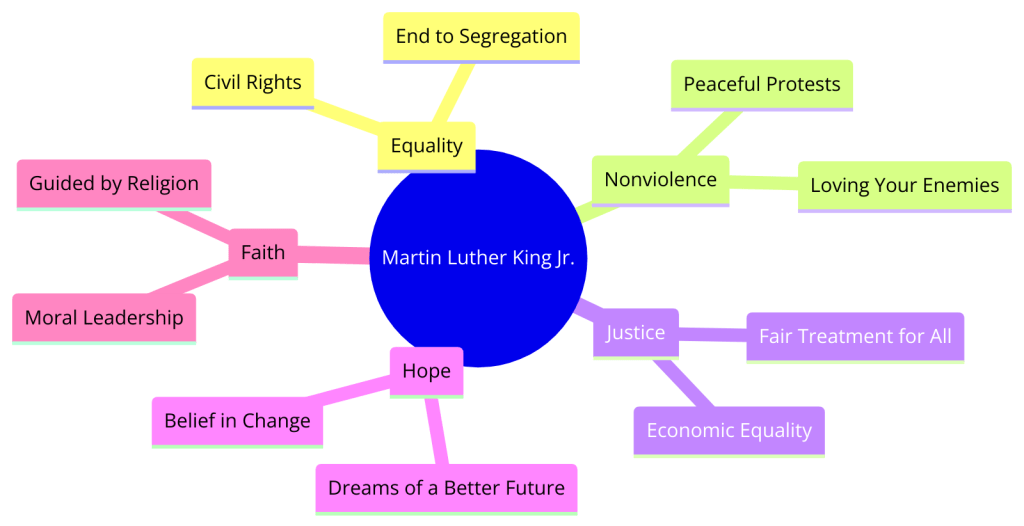
The recent creation of a mindmap of Martin Luther King Jr.’s ideas provides a clear visualization of his core beliefs and principles. This mindmap encapsulates five key areas: Equality, Nonviolence, Justice, Hope, and Faith. The mindmap of his concepts serves as a visual reminder of his profound wisdom and the timeless relevance of his teachings.
Equality
“I have a dream that my four little children will one day live in a nation where they will not be judged by the color of their skin, but by the content of their character.” – Martin Luther King Jr.
Central to King’s advocacy was the fight for equality. He tirelessly worked towards ending racial segregation and discrimination, championing civil rights and the right to vote for African Americans.
Nonviolence
“Nonviolence is a powerful and just weapon, which cuts without wounding and ennobles the man who wields it. It is a sword that heals.” – Martin Luther King Jr.
King was heavily influenced by Mahatma Gandhi’s philosophy of nonviolent resistance. He firmly believed in peaceful protests as a means to achieve social change.
Justice
“Injustice anywhere is a threat to justice everywhere. We are caught in an inescapable network of mutuality, tied in a single garment of destiny. Whatever affects one directly, affects all indirectly.” – Martin Luther King Jr.
Justice for all was a cornerstone of King’s vision. He advocated for fair treatment of all individuals, irrespective of race, and fought against economic disparities.
Hope
“We must accept finite disappointment, but never lose infinite hope.” – Martin Luther King Jr.
King was a beacon of hope during tumultuous times. He had an unshakeable belief in the possibility of change and a better future.
Faith
“Faith is taking the first step even when you don’t see the whole staircase.” – Martin Luther King Jr.
King’s actions were deeply rooted in his Christian faith and moral convictions. He viewed his civil rights activism as an extension of his religious duties.
The Enduring Impact of King’s Legacy
Martin Luther King Jr.’s ideas and actions reshaped American society and inspired movements worldwide. His legacy extends beyond the boundaries of civil rights; it encompasses the universal values of equality, peace, and human dignity. Each year, Martin Luther King Jr. Day is celebrated in his honor, reminding us of his contribution to making the world a more just and equitable place.
His life was tragically cut short when he was assassinated on April 4, 1968, but his ideals continue to resonate. His dream of a society where people are not judged by the color of their skin but by the content of their character remains a powerful and unfulfilled aspiration, driving continuous efforts towards equality and justice globally.
In essence, Martin Luther King Jr. was not just a leader of his time but a visionary whose ideas continue to influence and inspire.
 GPTs-and-Me