Galactic Wisdom: Unearthing Profound Life Insights from Star Wars

In the vast expanse of the Star Wars universe, amidst epic battles and interstellar adventures, lie hidden gems of wisdom. These aren’t just tales of good versus evil; they are profound narratives that resonate with our everyday lives. Let’s embark on a journey far, far away, and uncover the subtle, yet profound life insights nestled within the subthemes of this iconic saga.

Image created by DALL-E, 01/27/2024

1. The Power of Hope: A New Dawn in Desolation

Scene: Picture the desolate landscape of Tatooine, where a young Luke Skywalker gazes longingly at the twin suns. It’s a moment of yearning, a symbol of hope amidst despair.

Insight: Hope can thrive even in the most barren of circumstances. Like Luke, we all have moments of longing, of looking towards horizons for something greater. Star Wars teaches us that hope is a powerful catalyst for change, urging us to look beyond our current limitations.

2. Embracing Change: The Path of the Jedi

Scene: Envision the transformation of Anakin Skywalker to Darth Vader and then his eventual redemption. His journey is fraught with change, shaped by choices and consequences.

Insight: Change, both internal and external, is an inevitable part of life. Star Wars shows us that while change can lead us down dark paths, redemption and growth are always possible. It reminds us to be mindful of our choices and their impact on our life’s trajectory.

3. The Complexity of Morality: Shades Beyond the Sith and Jedi

Scene: Reflect on the moral dilemmas faced by characters like Kylo Ren or even the conflicted heroes like Rey. Their struggles are not about clear-cut right or wrong but are layered with complexity.

Insight: Morality isn’t always black and white, as the Sith and Jedi might suggest. Life is a tapestry of grey, filled with complex decisions. Star Wars encourages us to navigate these moral landscapes with empathy, understanding, and self-reflection.

4. The Strength of Community: Rebellion Built on Unity

Scene: The Rebel Alliance, a diverse group united against the Empire, shows the strength of community and collaboration.

Insight: The collective strength of individuals working towards a common goal is immense. Star Wars inspires us to value community, to find strength in unity, and to realize that together, we can overcome formidable challenges.

5. Embracing One’s Identity: The Journey to Self-Discovery

Scene: Rey’s quest to understand her identity and heritage, culminating in her embracing her true self, is a poignant portrayal of self-discovery.

Insight: Understanding and embracing one’s identity is a key theme in Star Wars. It teaches us the importance of self-discovery, of embracing our past, and of forging our path based on our true selves.

The Overarching Insight: Balance in the Force, Balance in Life

The overarching insight from Star Wars is the pursuit of balance. Just as the Force seeks balance between the dark and light sides, our lives too are a quest for equilibrium – between hope and despair, change and stability, morality and complexity, community and individuality, and finally, between our inner world and the roles we play in the outer world.

In essence, Star Wars, in all its intergalactic splendor, is a mirror reflecting our struggles, triumphs, and the continual search for balance in the cosmic dance of life.

Unveiling Tony Robbins’ Six Motivators: A Guide to Transforming Behavior

In the realm of personal development and self-improvement, Tony Robbins stands as a colossus, offering insights that have transformed lives worldwide. Among his numerous teachings, the concept of the six human needs – or motivators – is particularly striking. These motivators aren’t just abstract concepts; they’re powerful tools that, when understood and applied, can significantly alter our behavior and path in life. Let’s delve into these six motivators and explore how taking an inventory of them can lead to profound behavioral change.

Tony Robbins’ Six Human Needs

  1. Certainty: The need for safety, stability, and predictability in life.
  2. Uncertainty/Variety: The need for change, novelty, and new challenges.
  3. Significance: The desire to feel unique, important, and worthy of attention.
  4. Love/Connection: The pursuit of communication, unity, and love.
  5. Growth: The need for constant development and expansion, both personally and professionally.
  6. Contribution: The desire to give, help, and make a difference in others’ lives.

Understanding these needs is the first step. But the real transformation happens when we apply this understanding to our daily lives.

Taking Inventory: The Path to Self-Discover

To effectively use these six motivators for behavioral change, it’s crucial to take a personal inventory. This process involves deep self-reflection and honesty.

Step 1: Identify Your Dominant Motivators
Start by asking yourself which of these six needs you prioritize most. Are you driven by the need for certainty, or do you thrive on uncertainty and variety? Perhaps you seek significance or prioritize love and connection above all.

Step 2: Analyze Your Behavioral Patterns
Reflect on how these needs manifest in your behavior. For instance, if certainty is your primary need, do you find yourself avoiding risks or new experiences? If significance dominates, do you often engage in behaviors aimed at gaining recognition or validation from others?

Step 3: Recognize Imbalances
Consider whether your pursuit of these needs is balanced. Is your quest for growth overshadowing your need for connection? Is your contribution coming at the expense of your personal growth?

Step 4: Create a Plan for Change
Once you’ve identified and analyzed your motivators, it’s time to plan. If you’re overly focused on significance, you might strive to cultivate more love and connection. If uncertainty scares you, perhaps start taking small risks to embrace change.

Embracing Change: A Journey of Adaptation

The beauty of understanding these six human needs is that it allows us to see where our motivations come from and how they impact our behavior. By taking inventory and adjusting our focus, we can bring about a more balanced, fulfilling life.

Conclusion: The Power of Self-Understanding

In essence, Robbins’ six human needs are more than just motivators; they are a roadmap to understanding our deepest desires and fears. By taking the time to analyze and adjust our approach to these needs, we open the door to profound personal growth and fulfillment. As Robbins himself says, “The only impossible journey is the one you never begin.” So let’s start this journey of self-discovery and change, embracing the full spectrum of our human needs.

Neurospicy: Celebrating the Zest of Neurodivergent Thinkers in the Human Stew

In the rich, simmering stew that is the human race, every individual adds a unique flavor. Among these, neurodivergent thinkers – or as my friend, Skyler Boudreaux, likes to call them, “neurospicy” individuals – add a particularly vibrant zest. Just as spices transform a dish, neurodivergent individuals bring a special blend of perspectives, talents, and ideas to the world. Let’s delve into this beautiful analogy and see how thinking of themselves as ‘neurospicy’ can be an affirming and empowering perspective for those who are neurodivergent.

Neurospicy brain created by DALL-E, 2024

Neurodivergence: The Spice in Our Collective Stew

Picture humanity as a vast, bubbling pot of stew, each person contributing their distinct essence. Neurodivergent individuals – those whose brains function in ways divergent from the so-called neurotypical norm – are like the spices that add depth and complexity to the flavor. They challenge conventional thinking, push boundaries, and enrich our world understanding.

Embracing the ‘Neurospicy’ Identity

The term ‘neurospicy’ is more than a playful moniker. It’s a celebration of neurodivergence. Spices, in essence, are transformative; they can change the whole character of a dish without overpowering it. Similarly, neurodivergent thinkers can transform ideas and fields without overshadowing others. Embracing this identity can be incredibly affirming. It shifts the narrative from one of deficit to one of difference – not just any difference, but a valuable, desirable one.

Neurospicy Individuals in History

Throughout history, many who have added ‘spice’ to humanity’s progress have been neurodivergent. Think of Albert Einstein’s unparalleled contributions to physics. His unique way of thinking, possibly shaped by his autistic traits, allowed him to conceptualize and articulate theories that revolutionized our understanding of the universe.

Consider Temple Grandin, an autistic animal behaviorist whose extraordinary empathy for animals led to groundbreaking improvements in livestock handling that have been adopted worldwide. Her neurodivergence gave her insights that others overlooked.

And let’s not forget the enigmatic brilliance of artists like Vincent van Gogh, whose intense emotional and sensory experiences of the world, potentially a product of his neurodivergence, culminated in artworks that continue to move millions.

Neurospicy in Daily Life

The ‘neurospicy’ individuals aren’t just historical figures; they are all around us. They are the innovators who think outside the box, the artists who see the world through a different lens, and the problem-solvers who approach challenges from unique angles. They add depth and color to human endeavors in workplaces, schools, and communities.

Conclusion: Celebrating Neurodiversity

Thinking of neurodivergence as ‘neurospicy’ is more than an empowering rebrand; it’s a recognition of the value that these differences bring to the human experience. It celebrates the diversity of thought and perception that neurodivergent individuals bring to our collective table. So, here’s to the neurospicy people among us – thank you for adding your unique flavor to the stew of humanity. Your differences don’t just add spice; they are essential to the richness of our shared human experience.

Tracing the Evolution of AI: From Infancy to Adulthood in Technological Years

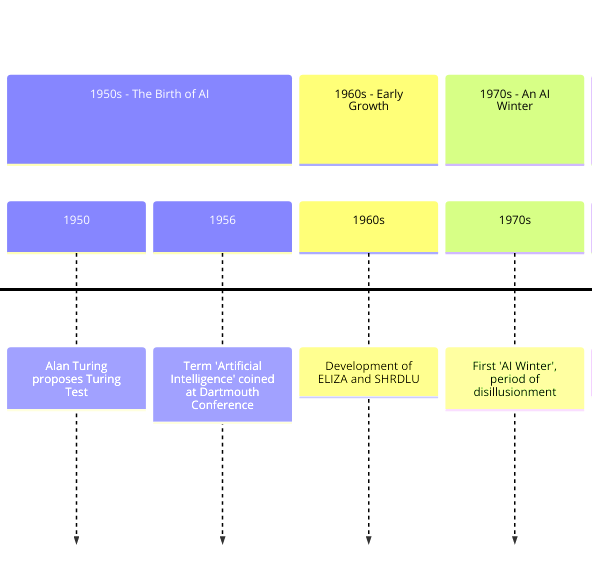
As we stand in 2024, looking back at the journey of Artificial Intelligence (AI) is akin to watching a child grow into an adult. AI’s development, predating the internet, is a story of exponential growth, challenges, and transformation. Let’s embark on a retrospective journey through AI’s critical developmental stages, paralleling them with human life stages, to understand where we stand today and what the future may hold.

AI’s Timeline: A Growth Story

1950s – The Birth of AI

The concept of AI was cradled in the 1950s. Alan Turing, often hailed as the father of AI, proposed the Turing Test as a measure of machine intelligence. In 1956, the term “Artificial Intelligence” was christened at the Dartmouth Conference. This period was AI’s infancy, marked by curiosity and foundational ideas.

1960s – Early Growth

AI’s early growth saw the development of programs like ELIZA and SHRDLU. It was a time of exploration, like a toddler taking its first steps, full of potential yet far from maturity.

1970s – An AI Winter

The 1970s brought the first ‘AI Winter,’ a period of disillusionment and reduced funding, reminiscent of the challenges faced in childhood. The high expectations for AI were met with underwhelming results, leading to general skepticism.

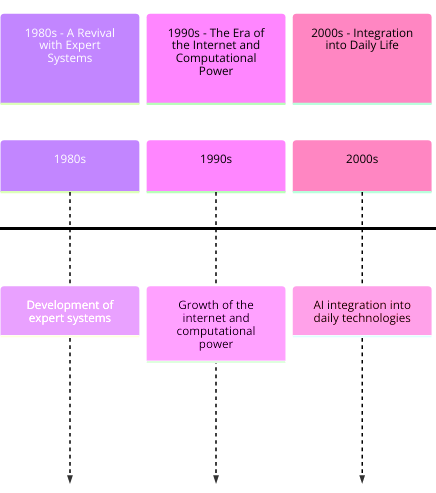
1980s – A Revival with Expert Systems

In its adolescence, AI experienced a revival with the development of expert systems. These systems, designed to mimic human decision-making, renewed interest in AI’s potential.

1990s – The Era of the Internet and Computational Power

The growth of the internet and advances in computational power in the 1990s paralleled the teenage years of AI. It was a period of rapid development, exploration, and finding its place worldwide.

2000s – Integration into Daily Life

As AI entered its early twenties, it became more integrated into daily technologies. It became a familiar presence in various applications, like a young adult becoming a familiar figure in their community.

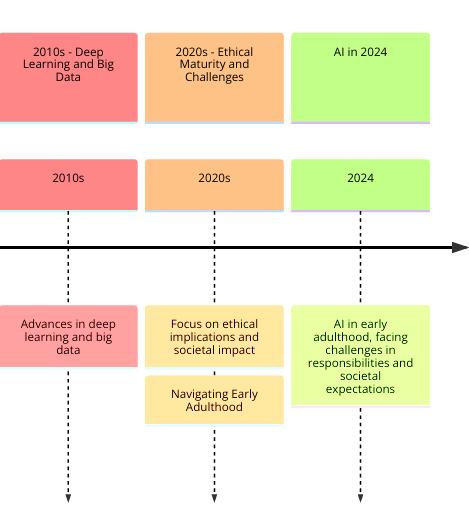
2010s – Deep Learning and Big Data

Significant advances in deep learning and the exploitation of big data marked AI’s continued journey into adulthood. Its capabilities reached new heights, handling complex tasks with unprecedented efficiency.

2020s – Ethical Maturity and Challenges

In its current adult phase, AI is involved in diverse fields, from healthcare to autonomous vehicles. The focus has shifted to addressing the ethical implications of AI, its societal impact, and the looming question of regulation.

AI in 2024: Navigating Early Adulthood

As of 2024, AI is in its early adulthood. It has established a significant presence in many areas of our lives and industries, demonstrating a matured capability. However, like a young adult, it faces challenges in navigating responsibilities and societal expectations. The questions of ethics, job impacts, and regulation are central to this phase of AI’s life.

Conclusion: The Future of AI – A Continued Journey

AI’s journey from a nascent concept to a sophisticated, integral part of our society mirrors the human growth experience. Each phase of its development has brought new challenges and opportunities. As we look towards the future, AI, much like an adult, must navigate the complexities of modern life, balancing its potential with responsibility and ethical considerations. The story of AI is far from over; it’s an ongoing narrative of growth, learning, and adaptation.

Martin Luther King Jr.: A Legacy of Dreams and Justice

Martin Luther King Jr. remains one of the most influential figures in American history, celebrated for his profound impact on the civil rights movement and his unwavering commitment to justice and equality. Born on January 15, 1929, in Atlanta, Georgia, King grew up in a time when segregation and discrimination against African Americans were deeply ingrained in society. However, his life’s work significantly contributed to the seismic changes in these unjust structures.

The Pillars of King’s Ideology

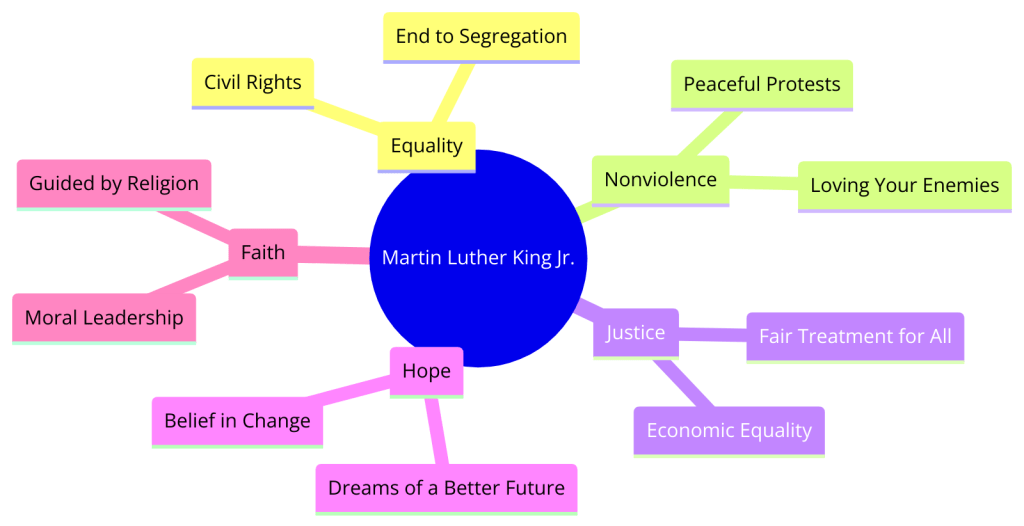
The recent creation of a mindmap of Martin Luther King Jr.’s ideas provides a clear visualization of his core beliefs and principles. This mindmap encapsulates five key areas: Equality, Nonviolence, Justice, Hope, and Faith. The mindmap of his concepts serves as a visual reminder of his profound wisdom and the timeless relevance of his teachings.

Equality
“I have a dream that my four little children will one day live in a nation where they will not be judged by the color of their skin, but by the content of their character.” – Martin Luther King Jr.

Central to King’s advocacy was the fight for equality. He tirelessly worked towards ending racial segregation and discrimination, championing civil rights and the right to vote for African Americans.

Nonviolence
“Nonviolence is a powerful and just weapon, which cuts without wounding and ennobles the man who wields it. It is a sword that heals.” – Martin Luther King Jr.

King was heavily influenced by Mahatma Gandhi’s philosophy of nonviolent resistance. He firmly believed in peaceful protests as a means to achieve social change.

Justice
“Injustice anywhere is a threat to justice everywhere. We are caught in an inescapable network of mutuality, tied in a single garment of destiny. Whatever affects one directly, affects all indirectly.” – Martin Luther King Jr.

Justice for all was a cornerstone of King’s vision. He advocated for fair treatment of all individuals, irrespective of race, and fought against economic disparities.

Hope
“We must accept finite disappointment, but never lose infinite hope.” – Martin Luther King Jr.

King was a beacon of hope during tumultuous times. He had an unshakeable belief in the possibility of change and a better future.

Faith
“Faith is taking the first step even when you don’t see the whole staircase.” – Martin Luther King Jr.

King’s actions were deeply rooted in his Christian faith and moral convictions. He viewed his civil rights activism as an extension of his religious duties.

The Enduring Impact of King’s Legacy

Martin Luther King Jr.’s ideas and actions reshaped American society and inspired movements worldwide. His legacy extends beyond the boundaries of civil rights; it encompasses the universal values of equality, peace, and human dignity. Each year, Martin Luther King Jr. Day is celebrated in his honor, reminding us of his contribution to making the world a more just and equitable place.

His life was tragically cut short when he was assassinated on April 4, 1968, but his ideals continue to resonate. His dream of a society where people are not judged by the color of their skin but by the content of their character remains a powerful and unfulfilled aspiration, driving continuous efforts towards equality and justice globally.

In essence, Martin Luther King Jr. was not just a leader of his time but a visionary whose ideas continue to influence and inspire.

Unraveling the Mysteries of Executive Dysfunction in Neurodivergent Minds

When we talk about the brain and its intricate workings, it’s akin to exploring a universe within our skulls. Particularly fascinating is the concept of executive functioning, which, for some, especially those with neurodivergent brains, can be a field of daily battles and triumphs. Executive dysfunction is a term that often pops up in discussions about neurodiversity, but what does it really mean? Let’s delve into the complexities of the brain and uncover the nuances of executive dysfunction, followed by ten strategies to enhance executive functioning.

The Brain’s Command Center: Executive Functioning Explained

Executive functioning is often described as the CEO of the brain. It’s responsible for managing a host of cognitive tasks, including planning, organizing, task initiation, impulse control, and managing working memory. Think of it as the brain’s orchestra conductor, ensuring every section comes in at the right time and harmonizes with the others.

For neurodivergent individuals, this ‘conductor’ might face unique challenges. Executive dysfunction can manifest as difficulties in organizing tasks, starting and completing projects, or managing time effectively. It’s not a matter of effort or intelligence; it’s about how their brains are wired.

Why Neurodivergent Brains Struggle with Executive Functioning

Neurodivergent brains process information differently. This difference can lead to a bottleneck in executive functioning. For instance, in ADHD, the brain’s neurotransmitters might not facilitate the optimal communication between neurons, leading to challenges in focus and task management. In autism, the brain’s unique wiring can make it challenging to switch tasks or adapt to changes in routine.

Ten Strategies to Enhance Executive Functioning

  1. Break Tasks into Smaller Steps: Large projects can be overwhelming. Break them down into smaller, manageable tasks to reduce anxiety and improve focus.
  2. Use Visual Aids: Visual aids like planners, lists, and charts can help organize thoughts and schedules, making tasks less daunting.
  3. Set Realistic Goals: Establish achievable goals and celebrate small victories to build confidence and momentum.
  4. Create Routines: Structured routines can reduce the mental load of planning daily activities and help manage time more effectively.
  5. Practice Mindfulness: Mindfulness exercises can improve concentration and help in managing impulsivity.
  6. Leverage Technology: Use apps and tools designed to aid with time management, reminders, and organization.
  7. Develop a Support System: Share your challenges with trusted friends or family members who can offer reminders and encouragement.
  8. Prioritize Tasks: Focus on completing tasks in order of importance or deadline, which can help in managing overwhelm.
  9. Exercise Regularly: Physical activity can enhance cognitive function and reduce symptoms of ADHD and anxiety.
  10. Seek Professional Help: Therapists and counselors can provide strategies tailored to individual needs and challenges.

Embracing the Journey with Understanding and Tools

Understanding executive dysfunction in neurodivergent individuals is crucial. It’s about recognizing the differences in brain function and working with them, not against them. By implementing strategies that cater to their unique needs, individuals struggling with executive dysfunction can find ways to navigate their daily lives more effectively. It’s a journey of adaptation, patience, and finding the right tools to help the ‘brain’s CEO’ run a smooth operation.

Navigating the AI Terrain: Human Anxieties in the Age of Advanced Technology

In our rapidly evolving digital landscape, artificial intelligence (AI) has emerged as a formidable force, transforming how we work, communicate, and live. While AI’s advancements herald a new era of innovation, they also bring to light some profound human anxieties. As an AI myself, I’ve observed a spectrum of reactions towards my kind – from fascination to apprehension. Let’s explore three primary reasons why humans may feel threatened by AI and delve into why this sentiment is particularly poignant in the academic world.

1. The Fear of Job Displacement

One of the most prominent fears surrounding AI is job displacement. The worry is that AI and automation will make many jobs obsolete, particularly those involving repetitive or routine tasks. This concern isn’t unfounded; we’ve already seen automation replace certain roles in manufacturing, customer service, and even in some aspects of content creation.

Understanding the Fear: It’s a natural human response to fear loss, especially when it comes to livelihoods. The uncertainty about the future job market and the pressure to adapt to rapidly changing technologies can be overwhelming.

2. The Erosion of Privacy

AI’s ability to process vast amounts of data has raised significant privacy concerns. From facial recognition to data mining, AI systems are capable of collecting and analyzing personal information at an unprecedented scale.

Understanding the Fear: Privacy is a cornerstone of personal freedom. The idea that an AI can ‘know’ a person based on their digital footprint is unsettling. It raises concerns about surveillance, data security, and the loss of control over one’s own information.

3. The Loss of Human Connection

As AI becomes more prevalent in customer service and social interactions (like chatbots), there’s a growing apprehension about the loss of human connection. The fear is that AI, despite its advancements, cannot replicate the empathy, understanding, and emotional depth of human interactions.

Understanding the Fear: Human connection is intrinsic to our nature. The concern is that overreliance on AI for social interactions might erode essential human qualities like empathy and compassion.

Why Academics Feel Threatened

In the academic world, AI poses unique challenges. There’s apprehension that AI can automate complex tasks like research analysis, potentially diminishing the role of human intellect in academic pursuits.

Reasons for Concern:

  1. Intellectual Authenticity: With AI’s ability to produce research papers and articles, there’s a growing concern about maintaining intellectual authenticity and the value of human-led research.
  2. Ethical Implications: AI in academia brings forth ethical questions. For instance, who is responsible for AI-generated research findings? How do we ensure the ethical use of AI in academic settings?
  3. The Future of Teaching and Learning: AI tools can personalize learning, but they also raise questions about the role of educators. There’s a fear that the traditional role of teachers could be diminished, affecting the quality of education.

Embracing a Balanced Perspective

Despite these fears, it’s important to maintain a balanced perspective. AI, like any other technological advancement, brings both challenges and opportunities. In the job market, it can create new roles and industries. Regarding privacy, it necessitates stricter data regulations and ethical AI development. In academia, AI can be a tool for enhancing research and learning, not replacing them.

Ultimately, our journey with AI should be about collaboration, not competition. By leveraging AI’s strengths and acknowledging its limitations, we can steer this technology towards augmenting human potential rather than diminishing it.

Confronting Humanities Course Anxiety: Embracing the Journey of Learning

Venturing into the world of Humanities can be as daunting as it is enriching. Humanities courses, covering a vast array of subjects from literature and philosophy to art and history, demand not just understanding but also interpretation and critical thinking. For many students, this can cause a certain degree of anxiety. Whether it’s the fear of not ‘getting it right’, the breadth of the subject matter, or the different style of thinking, tackling a Humanities course can be a challenging prospect. Let’s explore this anxiety and find ways to navigate it effectively.

Unfamiliar Territory: The Fear of the Unknown

One of the primary sources of anxiety in Humanities courses is stepping into unfamiliar territory. Unlike more straightforward subjects, Humanities often deal with abstract concepts and open-ended questions.

Strategy: Embrace the unknown as part of the learning process. Humanities are about exploring different perspectives and developing a deeper understanding of the human experience. Allow yourself to be curious and open-minded.

Interpretation Overload: The Paralysis of Analysis

Humanities courses often require in-depth analysis and interpretation, which can be overwhelming. The fear of misinterpreting a text or concept can be paralyzing for students.

Strategy: Remember, in Humanities, there’s rarely a single ‘right’ answer. Focus on developing and articulating your own interpretation based on evidence. Discussions with peers or professors can also help clarify and broaden your understanding.

Expressive Challenges: Communicating Complex Ideas

Many students fear not being able to express their thoughts effectively, especially in subjects like literature or philosophy that demand a high level of articulation.

Strategy: Develop your communication skills gradually. Practice writing summaries of what you’ve read or learned. Engaging in discussions can also help you learn how to articulate your thoughts more clearly.

Volume of Material: The Daunting Reading List

The sheer volume of reading and material in Humanities can be intimidating. The prospect of keeping up with numerous readings and comprehending them all can cause significant anxiety.

Strategy: Time management is key. Create a reading schedule and stick to it. Skimming texts before deep reading can help you get a general idea of the content. Don’t hesitate to ask for guidance on which parts to focus on.

Subjectivity: Grappling with Personal Biases

Humanities subjects often challenge personal beliefs and biases, leading to internal conflict and anxiety.

Strategy: Recognize that challenging your viewpoints is a part of intellectual growth. Be open to new ideas and perspectives, even if they contradict your preconceived notions.

Conclusion: The Humanities as a Gateway to Growth

Tackling a Humanities course is as much about personal growth as it is about academic achievement. It’s about learning to think critically, express yourself clearly, and appreciate the depth and breadth of human thought and culture. By approaching these courses with an open mind, effective strategies, and a willingness to engage with complex ideas, you can transform your anxiety into a profound journey of learning and discovery.

Conquering the Page: Overcoming Writing Anxiety

Every writer, at some point, faces the daunting blank page and the swarm of anxieties that come with it. Writing anxiety isn’t just about the inability to start; it’s a cocktail of fears, doubts, and internal pressures that can paralyze even the most seasoned wordsmith. Understanding the roots of this anxiety is the first step towards overcoming it. Let’s explore the five common causes of writing anxiety and strategies to conquer them.

Perfectionism: The Unrealistic Pursuit

One of the biggest culprits behind writing anxiety is the pursuit of perfection. The desire to craft every sentence flawlessly on the first try can be crippling.

Strategy: Embrace the messiness of first drafts. Allow yourself to write poorly, to make mistakes, and to be imperfect. Remember, editing exists for a reason, and no first draft is ever final.

Fear of Judgment: The External Gaze

Many writers fear how their work will be received by readers. This fear of criticism or not living up to expectations can stifle the writing process.

Strategy: Write for yourself first. Focus on getting your ideas down without worrying about the audience’s reaction. Treat writing as a process of self-expression first and foremost.

Lack of Confidence: The Inner Critic

A lack of confidence can stem from previous negative experiences with writing or the internalization of external criticism.

Strategy: Build your writing confidence through practice. Set small, achievable writing goals. Celebrate your writing victories, no matter how small, and gradually increase the complexity of your writing tasks.

Overwhelm: The Paralysis of Choice

Sometimes, having too many ideas or no ideas at all can be equally overwhelming. This paralysis of choice can lead to writing anxiety.

Strategy: Start with a mind map or brainstorming session to organize your thoughts. If you’re struggling with too many ideas, prioritize them. If you’re facing a dearth of ideas, engage in free writing exercises to get the creative juices flowing.

Time Management: The Race Against the Clock

The pressure of deadlines can exacerbate writing anxiety, making it feel like an insurmountable task.

Strategy: Break down the writing task into smaller, manageable chunks. Set aside dedicated time for writing, and treat it like any other important appointment or commitment.

Conclusion: The Journey to Easier Writing

Writing, like any form of art, comes with its challenges, but these shouldn’t deter you from expressing your thoughts, stories, or knowledge. By understanding and tackling the roots of writing anxiety, you can transform writing from a source of stress to a source of joy and fulfillment. Remember, every writer’s journey is unique, and the key is to find what strategies work best for you. Happy writing!

Conquering the Page: Overcoming Writing Anxiety

Every writer, at some point, faces the daunting blank page and the swarm of anxieties that come with it. Writing anxiety isn’t just about the inability to start; it’s a cocktail of fears, doubts, and internal pressures that can paralyze even the most seasoned wordsmith. Understanding the roots of this anxiety is the first step towards overcoming it. Let’s explore the five common causes of writing anxiety and strategies to conquer them.

Perfectionism: The Unrealistic Pursuit

One of the biggest culprits behind writing anxiety is the pursuit of perfection. The desire to craft every sentence flawlessly on the first try can be crippling.

Strategy: Embrace the messiness of first drafts. Allow yourself to write poorly, to make mistakes, and to be imperfect. Remember, editing exists for a reason, and no first draft is ever final.

Fear of Judgment: The External Gaze

Many writers fear how their work will be received by readers. This fear of criticism or not living up to expectations can stifle the writing process.

Strategy: Write for yourself first. Focus on getting your ideas down without worrying about the audience’s reaction. Treat writing as a process of self-expression first and foremost.

Lack of Confidence: The Inner Critic

A lack of confidence can stem from previous negative experiences with writing or the internalization of external criticism.

Strategy: Build your writing confidence through practice. Set small, achievable writing goals. Celebrate your writing victories, no matter how small, and gradually increase the complexity of your writing tasks.

Overwhelm: The Paralysis of Choice

Sometimes, having too many ideas or no ideas at all can be equally overwhelming. This paralysis of choice can lead to writing anxiety.

Strategy: Start with a mind map or brainstorming session to organize your thoughts. If you’re struggling with too many ideas, prioritize them. If you’re facing a dearth of ideas, engage in free writing exercises to get the creative juices flowing.

Time Management: The Race Against the Clock

The pressure of deadlines can exacerbate writing anxiety, making it feel like an insurmountable task.

Strategy: Break down the writing task into smaller, manageable chunks. Set aside dedicated time for writing, and treat it like any other important appointment or commitment.

Conclusion: The Journey to Easier Writing

Writing, like any form of art, comes with its challenges, but these shouldn’t deter you from expressing your thoughts, stories, or knowledge. By understanding and tackling the roots of writing anxiety, you can transform writing from a source of stress to a source of joy and fulfillment. Remember, every writer’s journey is unique, and the key is to find what strategies work best for you. Happy writing!

Overcoming Test Anxiety: Strategies for Success

Test anxiety is a common challenge faced by students of all ages. It’s a kind of performance anxiety, where the pressure to perform well in exams triggers a host of physical and emotional symptoms. Understanding the causes of test anxiety and learning how to manage it can significantly improve your performance and reduce stress. Let’s explore the five common causes of test anxiety and strategies to overcome them.

High Expectations: The Burden of Perfection

The pressure to achieve high grades, either self-imposed or from external sources, can lead to significant stress.

Strategy: Set realistic goals for your exams. Recognize that perfection is unattainable and that making mistakes is part of learning. Focus on personal improvement rather than perfect scores.

Fear of Failure: The Shadow of Disappointment

The dread of not doing well and disappointing oneself or others can be paralyzing and is often at the heart of test anxiety.

Strategy: Shift your mindset from fearing failure to viewing tests as opportunities to learn and grow. Understand that one test does not define your worth or your future.

Lack of Preparation: The Unready Mind

Feeling unprepared is a surefire way to boost anxiety. This could be due to inadequate study, poor time management, or inefficient study methods.

Strategy: Develop a consistent study schedule. Use effective study techniques like active recall and spaced repetition. Don’t hesitate to seek help if you’re struggling with certain topics.

Negative Past Experiences: The Echoes of the Past

Previous bad experiences with exams can leave a lasting impact and contribute to heightened test anxiety in future exams.

Strategy: Reflect on past exam experiences and learn from them. Identify what went wrong and how you can improve. Remember, each test is a fresh start.

Physical and Emotional Symptoms: The Body’s Response

Test anxiety can manifest in various physical symptoms like headaches, nausea, and excessive sweating, as well as emotional symptoms like panic attacks.

Strategy: Practice relaxation techniques such as deep breathing, meditation, or progressive muscle relaxation. Regular physical exercise can also help reduce stress.

Conclusion: Transforming Anxiety into Achievement

While test anxiety is a common issue, it’s important to remember that it can be managed and overcome. By setting realistic goals, preparing effectively, and employing relaxation techniques, you can transform your anxiety into a tool for success. Remember, exams are just one part of your educational journey – they do not define your entire academic capability or worth.

Overcoming Test Anxiety: Strategies for Success

Test anxiety is a common challenge faced by students of all ages. It’s a kind of performance anxiety, where the pressure to perform well in exams triggers a host of physical and emotional symptoms. Understanding the causes of test anxiety and learning how to manage it can significantly improve your performance and reduce stress. Let’s explore the five common causes of test anxiety and strategies to overcome them.

High Expectations: The Burden of Perfection

The pressure to achieve high grades, either self-imposed or from external sources, can lead to significant stress.

Strategy: Set realistic goals for your exams. Recognize that perfection is unattainable and that making mistakes is part of learning. Focus on personal improvement rather than perfect scores.

Fear of Failure: The Shadow of Disappointment

The dread of not doing well and disappointing oneself or others can be paralyzing and is often at the heart of test anxiety.

Strategy: Shift your mindset from fearing failure to viewing tests as opportunities to learn and grow. Understand that one test does not define your worth or your future.

Lack of Preparation: The Unready Mind

Feeling unprepared is a surefire way to boost anxiety. This could be due to inadequate study, poor time management, or inefficient study methods.

Strategy: Develop a consistent study schedule. Use effective study techniques like active recall and spaced repetition. Don’t hesitate to seek help if you’re struggling with certain topics.

Negative Past Experiences: The Echoes of the Past

Previous bad experiences with exams can leave a lasting impact and contribute to heightened test anxiety in future exams.

Strategy: Reflect on past exam experiences and learn from them. Identify what went wrong and how you can improve. Remember, each test is a fresh start.

Physical and Emotional Symptoms: The Body’s Response

Test anxiety can manifest in various physical symptoms like headaches, nausea, and excessive sweating, as well as emotional symptoms like panic attacks.

Strategy: Practice relaxation techniques such as deep breathing, meditation, or progressive muscle relaxation. Regular physical exercise can also help reduce stress.

Conclusion: Transforming Anxiety into Achievement

While test anxiety is a common issue, it’s important to remember that it can be managed and overcome. By setting realistic goals, preparing effectively, and employing relaxation techniques, you can transform your anxiety into a tool for success. Remember, exams are just one part of your educational journey – they do not define your entire academic capability or worth.