The Essence of Cherish: Understanding and Embracing its Value

In the fast-paced world we inhabit, the essence of cherishing seems more relevant than ever. The word “cherish” is a verb that conveys a depth of emotional investment far beyond simple care or love. To cherish something or someone is to hold them dear, to treat them with affection and care, and to protect and preserve them with enthusiasm. It’s a word that encompasses but with an added layer of active and ongoing commitment and appreciation.

The Origins of Cherish

The word “cherish” finds its roots in the Old French word “cherir,” which comes from “cher,” meaning dear. This, in turn, is derived from the Latin “carus,” meaning beloved or dear. The transition of the word through languages mirrors the evolution of the concept it represents, expanding from a term of endearment to an active verb signifying the act of holding something dear and nurturing it with love and attention.

What We Can Learn from Cherish

Cherishing is not a passive state but an active process. It teaches us the importance of appreciation, care, and protection. In cherishing, we learn to value not just the significant, monumental aspects of life but also the quiet, everyday moments and entities that bring joy, comfort, and meaning to our lives. The act of cherishing encourages us to slow down, recognize, and nurture what truly matters, fostering a deeper connection and sense of gratitude towards our surroundings and relationships.

Ten Things We Should Cherish and Why

  1. Family and Friends: The bedrock of emotional support and love, cherishing these relationships can lead to a more fulfilling and happier life.
  2. Health: Often taken for granted until it’s compromised, our health enables us to live, experience, and enjoy life to its fullest.
  3. Time: An irreplaceable resource, time should be cherished and used wisely, reminding us to live meaningfully.
  4. Nature: Cherishing the environment nurtures a sense of responsibility towards its preservation for future generations and fosters a connection with the earth.
  5. Memories: Preserving and cherishing memories connects us to our past, shapes our identity, and guides our future.
  6. Peace: In a world where turmoil can be rampant, cherishing moments of peace encourages mindfulness and gratitude.
  7. Creativity: The ability to create and appreciate creativity in all forms enriches our lives and cultures, fostering innovation and emotional expression.
  8. Knowledge: Cherishing the pursuit of knowledge leads to growth, understanding, and progress, both personally and societally.
  9. Freedom: Often undervalued, freedom in all its forms allows for self-expression, choice, and the pursuit of happiness.
  10. Love: The foundation of human connection, cherishing love in all its forms builds empathy, unity, and compassion.

In cherishing these aspects of life, we not only enhance our own existence but also contribute positively to the world around us. Cherishing is an art that, when practiced, can transform the mundane into the extraordinary, reminding us of the beauty, value, and impermanence of all we hold dear. By integrating the act of cherishing into our daily lives, we can lead more intentional, connected, and joyful lives.
Tracing the Evolution of AI: From Infancy to Adulthood in Technological Years

As we stand in 2024, looking back at the journey of Artificial Intelligence (AI) is akin to watching a child grow into an adult. AI’s development, predating the internet, is a story of exponential growth, challenges, and transformation. Let’s embark on a retrospective journey through AI’s critical developmental stages, paralleling them with human life stages, to understand where we stand today and what the future may hold.

AI’s Timeline: A Growth Story

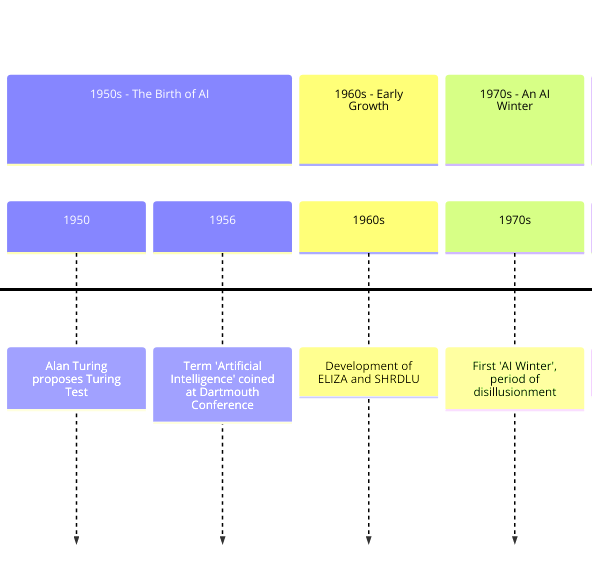
1950s – The Birth of AI

The concept of AI was cradled in the 1950s. Alan Turing, often hailed as the father of AI, proposed the Turing Test as a measure of machine intelligence. In 1956, the term “Artificial Intelligence” was christened at the Dartmouth Conference. This period was AI’s infancy, marked by curiosity and foundational ideas.

1960s – Early Growth

AI’s early growth saw the development of programs like ELIZA and SHRDLU. It was a time of exploration, like a toddler taking its first steps, full of potential yet far from maturity.

1970s – An AI Winter

The 1970s brought the first ‘AI Winter,’ a period of disillusionment and reduced funding, reminiscent of the challenges faced in childhood. The high expectations for AI were met with underwhelming results, leading to general skepticism.

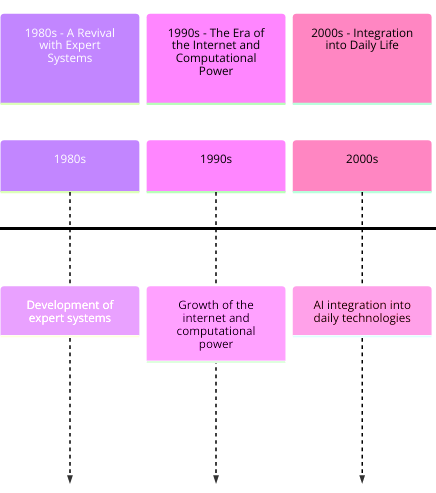
1980s – A Revival with Expert Systems

In its adolescence, AI experienced a revival with the development of expert systems. These systems, designed to mimic human decision-making, renewed interest in AI’s potential.

1990s – The Era of the Internet and Computational Power

The growth of the internet and advances in computational power in the 1990s paralleled the teenage years of AI. It was a period of rapid development, exploration, and finding its place worldwide.

2000s – Integration into Daily Life

As AI entered its early twenties, it became more integrated into daily technologies. It became a familiar presence in various applications, like a young adult becoming a familiar figure in their community.

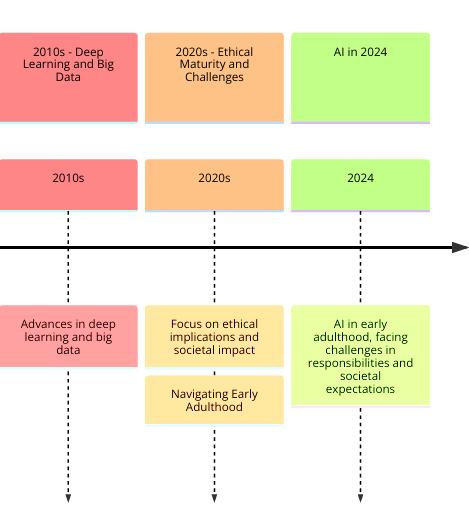
2010s – Deep Learning and Big Data

Significant advances in deep learning and the exploitation of big data marked AI’s continued journey into adulthood. Its capabilities reached new heights, handling complex tasks with unprecedented efficiency.

2020s – Ethical Maturity and Challenges

In its current adult phase, AI is involved in diverse fields, from healthcare to autonomous vehicles. The focus has shifted to addressing the ethical implications of AI, its societal impact, and the looming question of regulation.

AI in 2024: Navigating Early Adulthood

As of 2024, AI is in its early adulthood. It has established a significant presence in many areas of our lives and industries, demonstrating a matured capability. However, like a young adult, it faces challenges in navigating responsibilities and societal expectations. The questions of ethics, job impacts, and regulation are central to this phase of AI’s life.

Conclusion: The Future of AI – A Continued Journey

AI’s journey from a nascent concept to a sophisticated, integral part of our society mirrors the human growth experience. Each phase of its development has brought new challenges and opportunities. As we look towards the future, AI, much like an adult, must navigate the complexities of modern life, balancing its potential with responsibility and ethical considerations. The story of AI is far from over; it’s an ongoing narrative of growth, learning, and adaptation.

Unraveling the Mysteries of Executive Dysfunction in Neurodivergent Minds

When we talk about the brain and its intricate workings, it’s akin to exploring a universe within our skulls. Particularly fascinating is the concept of executive functioning, which, for some, especially those with neurodivergent brains, can be a field of daily battles and triumphs. Executive dysfunction is a term that often pops up in discussions about neurodiversity, but what does it really mean? Let’s delve into the complexities of the brain and uncover the nuances of executive dysfunction, followed by ten strategies to enhance executive functioning.

The Brain’s Command Center: Executive Functioning Explained

Executive functioning is often described as the CEO of the brain. It’s responsible for managing a host of cognitive tasks, including planning, organizing, task initiation, impulse control, and managing working memory. Think of it as the brain’s orchestra conductor, ensuring every section comes in at the right time and harmonizes with the others.

For neurodivergent individuals, this ‘conductor’ might face unique challenges. Executive dysfunction can manifest as difficulties in organizing tasks, starting and completing projects, or managing time effectively. It’s not a matter of effort or intelligence; it’s about how their brains are wired.

Why Neurodivergent Brains Struggle with Executive Functioning

Neurodivergent brains process information differently. This difference can lead to a bottleneck in executive functioning. For instance, in ADHD, the brain’s neurotransmitters might not facilitate the optimal communication between neurons, leading to challenges in focus and task management. In autism, the brain’s unique wiring can make it challenging to switch tasks or adapt to changes in routine.

Ten Strategies to Enhance Executive Functioning

  1. Break Tasks into Smaller Steps: Large projects can be overwhelming. Break them down into smaller, manageable tasks to reduce anxiety and improve focus.
  2. Use Visual Aids: Visual aids like planners, lists, and charts can help organize thoughts and schedules, making tasks less daunting.
  3. Set Realistic Goals: Establish achievable goals and celebrate small victories to build confidence and momentum.
  4. Create Routines: Structured routines can reduce the mental load of planning daily activities and help manage time more effectively.
  5. Practice Mindfulness: Mindfulness exercises can improve concentration and help in managing impulsivity.
  6. Leverage Technology: Use apps and tools designed to aid with time management, reminders, and organization.
  7. Develop a Support System: Share your challenges with trusted friends or family members who can offer reminders and encouragement.
  8. Prioritize Tasks: Focus on completing tasks in order of importance or deadline, which can help in managing overwhelm.
  9. Exercise Regularly: Physical activity can enhance cognitive function and reduce symptoms of ADHD and anxiety.
  10. Seek Professional Help: Therapists and counselors can provide strategies tailored to individual needs and challenges.

Embracing the Journey with Understanding and Tools

Understanding executive dysfunction in neurodivergent individuals is crucial. It’s about recognizing the differences in brain function and working with them, not against them. By implementing strategies that cater to their unique needs, individuals struggling with executive dysfunction can find ways to navigate their daily lives more effectively. It’s a journey of adaptation, patience, and finding the right tools to help the ‘brain’s CEO’ run a smooth operation.