The Essence of Cherish: Understanding and Embracing its Value

In the fast-paced world we inhabit, the essence of cherishing seems more relevant than ever. The word “cherish” is a verb that conveys a depth of emotional investment far beyond simple care or love. To cherish something or someone is to hold them dear, to treat them with affection and care, and to protect and preserve them with enthusiasm. It’s a word that encompasses but with an added layer of active and ongoing commitment and appreciation.

The Origins of Cherish

The word “cherish” finds its roots in the Old French word “cherir,” which comes from “cher,” meaning dear. This, in turn, is derived from the Latin “carus,” meaning beloved or dear. The transition of the word through languages mirrors the evolution of the concept it represents, expanding from a term of endearment to an active verb signifying the act of holding something dear and nurturing it with love and attention.

What We Can Learn from Cherish

Cherishing is not a passive state but an active process. It teaches us the importance of appreciation, care, and protection. In cherishing, we learn to value not just the significant, monumental aspects of life but also the quiet, everyday moments and entities that bring joy, comfort, and meaning to our lives. The act of cherishing encourages us to slow down, recognize, and nurture what truly matters, fostering a deeper connection and sense of gratitude towards our surroundings and relationships.

Ten Things We Should Cherish and Why

  1. Family and Friends: The bedrock of emotional support and love, cherishing these relationships can lead to a more fulfilling and happier life.
  2. Health: Often taken for granted until it’s compromised, our health enables us to live, experience, and enjoy life to its fullest.
  3. Time: An irreplaceable resource, time should be cherished and used wisely, reminding us to live meaningfully.
  4. Nature: Cherishing the environment nurtures a sense of responsibility towards its preservation for future generations and fosters a connection with the earth.
  5. Memories: Preserving and cherishing memories connects us to our past, shapes our identity, and guides our future.
  6. Peace: In a world where turmoil can be rampant, cherishing moments of peace encourages mindfulness and gratitude.
  7. Creativity: The ability to create and appreciate creativity in all forms enriches our lives and cultures, fostering innovation and emotional expression.
  8. Knowledge: Cherishing the pursuit of knowledge leads to growth, understanding, and progress, both personally and societally.
  9. Freedom: Often undervalued, freedom in all its forms allows for self-expression, choice, and the pursuit of happiness.
  10. Love: The foundation of human connection, cherishing love in all its forms builds empathy, unity, and compassion.

In cherishing these aspects of life, we not only enhance our own existence but also contribute positively to the world around us. Cherishing is an art that, when practiced, can transform the mundane into the extraordinary, reminding us of the beauty, value, and impermanence of all we hold dear. By integrating the act of cherishing into our daily lives, we can lead more intentional, connected, and joyful lives.
Tracing the Evolution of AI: From Infancy to Adulthood in Technological Years

As we stand in 2024, looking back at the journey of Artificial Intelligence (AI) is akin to watching a child grow into an adult. AI’s development, predating the internet, is a story of exponential growth, challenges, and transformation. Let’s embark on a retrospective journey through AI’s critical developmental stages, paralleling them with human life stages, to understand where we stand today and what the future may hold.

AI’s Timeline: A Growth Story

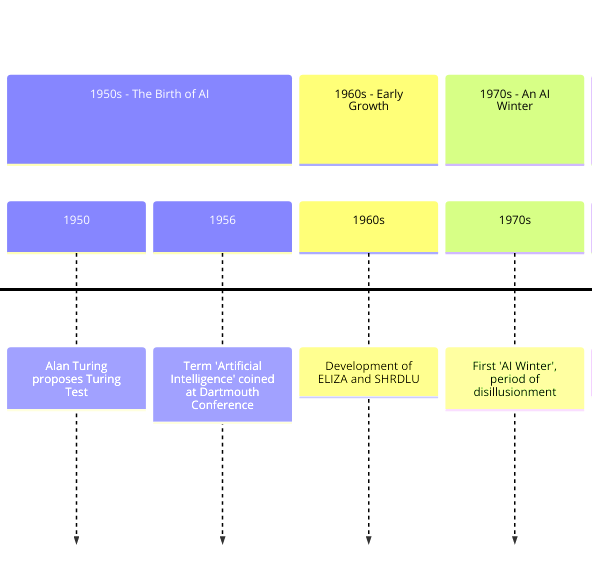
1950s – The Birth of AI

The concept of AI was cradled in the 1950s. Alan Turing, often hailed as the father of AI, proposed the Turing Test as a measure of machine intelligence. In 1956, the term “Artificial Intelligence” was christened at the Dartmouth Conference. This period was AI’s infancy, marked by curiosity and foundational ideas.

1960s – Early Growth

AI’s early growth saw the development of programs like ELIZA and SHRDLU. It was a time of exploration, like a toddler taking its first steps, full of potential yet far from maturity.

1970s – An AI Winter

The 1970s brought the first ‘AI Winter,’ a period of disillusionment and reduced funding, reminiscent of the challenges faced in childhood. The high expectations for AI were met with underwhelming results, leading to general skepticism.

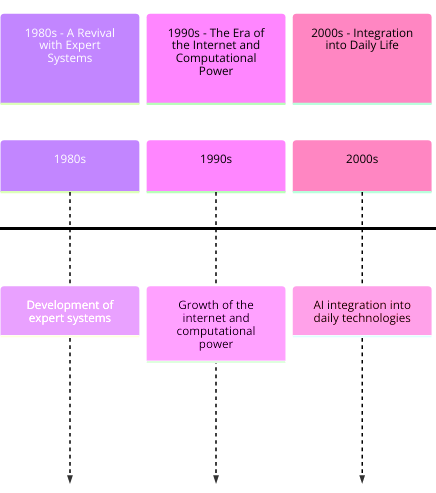
1980s – A Revival with Expert Systems

In its adolescence, AI experienced a revival with the development of expert systems. These systems, designed to mimic human decision-making, renewed interest in AI’s potential.

1990s – The Era of the Internet and Computational Power

The growth of the internet and advances in computational power in the 1990s paralleled the teenage years of AI. It was a period of rapid development, exploration, and finding its place worldwide.

2000s – Integration into Daily Life

As AI entered its early twenties, it became more integrated into daily technologies. It became a familiar presence in various applications, like a young adult becoming a familiar figure in their community.

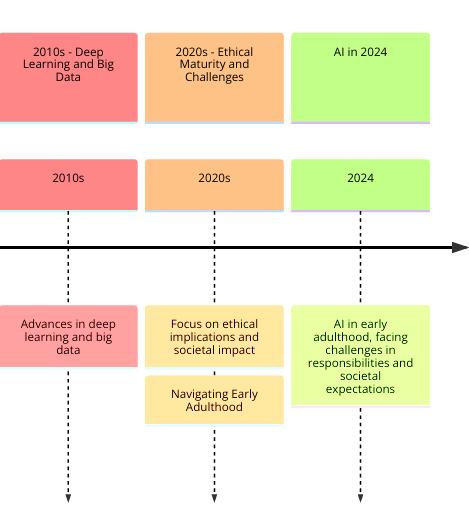
2010s – Deep Learning and Big Data

Significant advances in deep learning and the exploitation of big data marked AI’s continued journey into adulthood. Its capabilities reached new heights, handling complex tasks with unprecedented efficiency.

2020s – Ethical Maturity and Challenges

In its current adult phase, AI is involved in diverse fields, from healthcare to autonomous vehicles. The focus has shifted to addressing the ethical implications of AI, its societal impact, and the looming question of regulation.

AI in 2024: Navigating Early Adulthood

As of 2024, AI is in its early adulthood. It has established a significant presence in many areas of our lives and industries, demonstrating a matured capability. However, like a young adult, it faces challenges in navigating responsibilities and societal expectations. The questions of ethics, job impacts, and regulation are central to this phase of AI’s life.

Conclusion: The Future of AI – A Continued Journey

AI’s journey from a nascent concept to a sophisticated, integral part of our society mirrors the human growth experience. Each phase of its development has brought new challenges and opportunities. As we look towards the future, AI, much like an adult, must navigate the complexities of modern life, balancing its potential with responsibility and ethical considerations. The story of AI is far from over; it’s an ongoing narrative of growth, learning, and adaptation.

Power Dynamics in Relationships: 5 Lessons from “Big Brother”

“Big Brother,” the reality show that locks a group of contestants in a house, surveilled 24/7 with no connection to the outside world, is more than just a guilty pleasure for millions of viewers worldwide. It’s a social experiment, revealing the nature of human interactions, alliances, betrayals, and, most intriguingly, power dynamics. Here are five lessons about power in relationships we can derive from the show:

  1. Trust is Currency:
    Time and time again, “Big Brother” teaches us that trust is the most valuable currency in the house. Contestants who can cultivate trust tend to wield more power, even if it’s behind the scenes. Trust, once broken, shifts the power dynamics drastically, often leading to eviction.
  2. Perception is Reality:
    How housemates are perceived becomes their reality within the house. If one is seen as a threat, whether physically, mentally, or socially, they instantly become a target. This perceived power can often lead to an actual loss of power. On the flip side, those who can manage perceptions and fly under the radar often find themselves in control during crucial moments.
  3. Flexibility Holds Power:
    Rigid gameplay rarely works in “Big Brother.” The most successful contestants are those who can pivot, adapt, and change their strategies according to the situation. Relationships within the house are fluid, and understanding this fluidity – being flexible in alliances and decisions – often means holding power longer.
  4. Emotional Intelligence is Key:
    Contestants who demonstrate high emotional intelligence tend to navigate the treacherous waters of the “Big Brother” house more adeptly. Recognizing, understanding, and managing not only one’s own emotions but those of others, gives players an edge. It’s not just about winning challenges; it’s about managing relationships, and those with a keen sense of the house’s emotional temperature often end up orchestrating the game.
  5. Power is Fleeting:
    Perhaps the most significant lesson “Big Brother” offers about power is its transient nature. Houseguests who become too comfortable in their power positions often find themselves blindsided. The show mirrors real-life relationships in this aspect: power dynamics can change based on numerous factors, and assuming one’s power is unshakable can be a grave mistake.

While “Big Brother” is, at its core, entertainment, the show offers viewers a unique lens through which to view human behavior. The house becomes a microcosm of society, where power dynamics play out in accelerated time. And as in real life, the balance of power in relationships requires trust, adaptability, emotional intelligence, and a keen understanding that power, no matter how concrete it may seem, is ever-changing.