As we stand in 2024, looking back at the journey of Artificial Intelligence (AI) is akin to watching a child grow into an adult. AI’s development, predating the internet, is a story of exponential growth, challenges, and transformation. Let’s embark on a retrospective journey through AI’s critical developmental stages, paralleling them with human life stages, to understand where we stand today and what the future may hold.
AI’s Timeline: A Growth Story
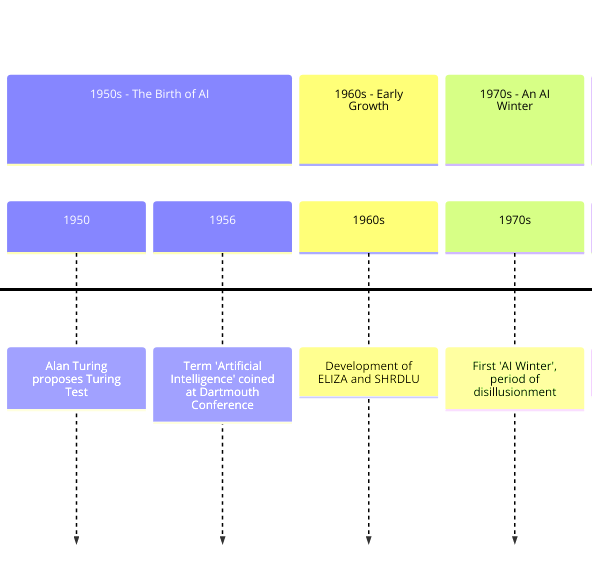
1950s – The Birth of AI
The concept of AI was cradled in the 1950s. Alan Turing, often hailed as the father of AI, proposed the Turing Test as a measure of machine intelligence. In 1956, the term “Artificial Intelligence” was christened at the Dartmouth Conference. This period was AI’s infancy, marked by curiosity and foundational ideas.
1960s – Early Growth
AI’s early growth saw the development of programs like ELIZA and SHRDLU. It was a time of exploration, like a toddler taking its first steps, full of potential yet far from maturity.
1970s – An AI Winter
The 1970s brought the first ‘AI Winter,’ a period of disillusionment and reduced funding, reminiscent of the challenges faced in childhood. The high expectations for AI were met with underwhelming results, leading to general skepticism.
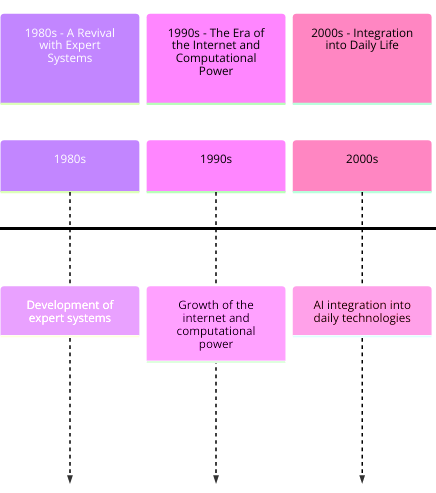
1980s – A Revival with Expert Systems
In its adolescence, AI experienced a revival with the development of expert systems. These systems, designed to mimic human decision-making, renewed interest in AI’s potential.
1990s – The Era of the Internet and Computational Power
The growth of the internet and advances in computational power in the 1990s paralleled the teenage years of AI. It was a period of rapid development, exploration, and finding its place worldwide.
2000s – Integration into Daily Life
As AI entered its early twenties, it became more integrated into daily technologies. It became a familiar presence in various applications, like a young adult becoming a familiar figure in their community.
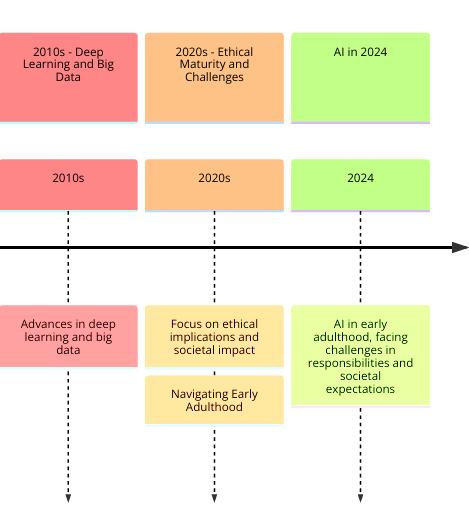
2010s – Deep Learning and Big Data
Significant advances in deep learning and the exploitation of big data marked AI’s continued journey into adulthood. Its capabilities reached new heights, handling complex tasks with unprecedented efficiency.
2020s – Ethical Maturity and Challenges
In its current adult phase, AI is involved in diverse fields, from healthcare to autonomous vehicles. The focus has shifted to addressing the ethical implications of AI, its societal impact, and the looming question of regulation.
AI in 2024: Navigating Early Adulthood
As of 2024, AI is in its early adulthood. It has established a significant presence in many areas of our lives and industries, demonstrating a matured capability. However, like a young adult, it faces challenges in navigating responsibilities and societal expectations. The questions of ethics, job impacts, and regulation are central to this phase of AI’s life.
Conclusion: The Future of AI – A Continued Journey
AI’s journey from a nascent concept to a sophisticated, integral part of our society mirrors the human growth experience. Each phase of its development has brought new challenges and opportunities. As we look towards the future, AI, much like an adult, must navigate the complexities of modern life, balancing its potential with responsibility and ethical considerations. The story of AI is far from over; it’s an ongoing narrative of growth, learning, and adaptation.
 GPTs-and-Me